
Chapter 1: Desolate Landscape and Emotional Scenery
1.1 Defining the “Desolate Landscape”: From Emptiness to Spiritual Stillness
In common usage, desolate often implies barrenness or abandonment. In my context, however, it signifies an elevated form of self-presence. The emptiness of a landscape does not suggest lack, but rather invites the viewer to return to themselves, activating a tactile relationship between body and space. This connects to the phenomenological idea of felt space and atmosphere: as Merleau-Ponty argues, “the body is our general medium for having a world” (Merleau-Ponty, 1962: 146). In the smallest and quietest space, we may reach what Bachelard calls an “intimate immensity” (Bachelard, 1994: 183–185).

Zeqi Tang. (2025) Portrait of a Moonlit Night I .Oil on wood. 30x20cm. Artist's collection.
Zeqi Tang. (2025) Portrait of a Moonlit Night II.Oil on canvas. 40x30cm. Artist's collection.
Trigg further expands this by describing atmosphere as an affective field that arises between subject and world (Trigg, 2020: 15–28). In my paintings, this atmosphere is built through low horizons, restrained colour tones, and large areas of open space. Emptiness here gains emotional density—it becomes charged with absence. Such “presence in desolation” continues the Romantic tradition of landscape as a mirror of the soul, while also resonating with the Chinese literati ideal of cultivating the spirit through emptiness and stillness.
1.2 Finnish Snow Night: Memory, Displacement, and the “Uncanny Familiar”

Zeqi Tang(2025) Winter Landscape in Romiguières [Photograph]. Rovaniemi, Finland.
My understanding of the desolate grew from a winter journey in Finland in search of the aurora. The frozen air, the muffled sound of snow under boots, and the dark forest together created a calm, stable atmosphere. Waiting inside a Sami wooden hut or walking on the frozen lake, I unexpectedly felt safe and peaceful. This felt space—formed by coldness, silence, and thin light—recalled my childhood winters in China: the snow was familiar, yet the tension once tied to home was gone.
This displacement between place and memory—being both like home and not home—illustrates what Trigg describes as the uncanny, the sense of estrangement within the familiar (Trigg, 2012: 101–132). The northern cold and silence became a container for emotion, allowing me to re-locate feelings that could not be resolved in their original context. That is why in my paintings, emptiness is never hollow—it is a witnessed emotional space.
1.3 From the Sublime to the Emotional Landscape: Spiritual Space in Art History
Caspar David Friedrich’s Wanderer above the Sea of Fog (1818) serves as a visual prototype for my “desolate landscapes.” The Rückenfigur—the lone figure seen from behind—stands before a sea of mist. This is not only a vision of Romantic sublimity but also an existential moment of confronting infinity. As Koerner observes, the figure creates a double structure of vision: we both look at him and through him (Koerner, 2009: 210–219). This mediated gaze turns solitude into a shared experience.

Friedrich, C. D. (1818) Wanderer above the Sea of Fog [Oil on canvas]. Kunsthalle Hamburg, Hamburg.
Even more influential for me is Friedrich’s Tetschen Altar (1808), which uses only fir trees and a mountain cross to evoke a sacred atmosphere. Without narrative or human presence, it expresses spirituality purely through the composition of natural elements. This strategy of absence as presence inspired me to let landscape itself embody emotion—the posture of trees, the path of light, and the gaps of space all become ways to evoke inner resonance.

Friedrich, C. D. (1808) The Cross in the Mountains (Tetschen Altar) [Oil on canvas]. Galerie Neue Meister, Dresden.
Lonely Pines and Longing: From Canada to China

Thomson, T. (1917) The Jack Pine [Oil on canvas]. National Gallery of Canada, Ottawa.
Tom Thomson’s The Jack Pine (1917) brings this emotional landscape into another register. The solitary pine on a northern lake shore, its twisted branches shaped by the wind, feels like an outward trace of emotion. It reminds me of the willow in Chinese art and poetry—homophonous with liú (to stay), symbolising parting and affection.Within Chinese culture, natural motifs carry emotional codes: the plum for integrity, the bamboo for resilience, the willow for attachment.

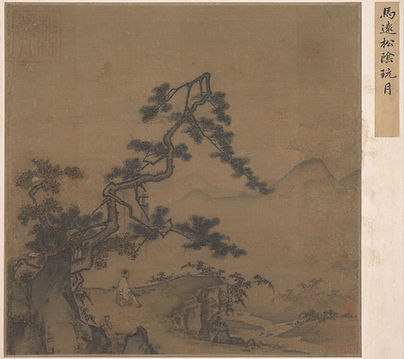
The moon occupies a special position in this symbolic system. It is both the collective emotional anchor in "Gazing at the bright moon together, we should shed tears," and the companion to solitude in "Raising my cup, I invite the bright moon; with my shadow we become three." Southern Song painter Ma Yuan's Enjoying the Moon in a Pine Grove and Appreciating Plum Blossoms under the Moon depict another kind of solitude in the literati ideal: not passive isolation, but actively chosen spiritual self-sufficiency. Moon-gazing, appreciating plum blossoms, playing the qin under moonlight—these refined gatherings of the literati require no clamorous audience; the moon itself is the understanding companion. This "nobility" is not moral superiority, but the capacity to create meaning while acknowledging solitude.
Ma Yuan (c. 1200) Enjoying the Moon in a Pine Grove [Ink and color on silk]. Collection unknown.
Ma Yuan (c. 1200) Appreciating Plum Blossoms under the Moon [Ink and color on silk]. Collection unknown.
Moral Ideals and Spiritual Landscapes
Here lies a fundamental difference between Western and Chinese painting. While Western art often aims for representation, the literati tradition seeks the expression of moral or spiritual ideals. Huang Gongwang’s Dwelling in the Fuchun Mountains is less a depiction of geography than an embodiment of the ability to stay calm amid turmoil.
My “desolate landscapes” operate between these two traditions: the Romantic sublime of confronting infinity, and the literati expression of cultivated stillness. When I paint moonlit nights or empty snowfields, I am not recording a site but constructing a spiritual space—where solitude becomes fullness and silence becomes another way of speaking.
My desolate landscapes operate within both Eastern and Western visual and philosophical lineages, aiming to construct a contemporary spiritual space. Through the embodied memory of a Finnish snow night, the Sisyphean repetition of painting, and the dialogue between Friedrich and Chinese literati traditions, I transform solitude from a state of lack into one of presence. These empty landscapes are not escapes from reality but essential zones for recalibrating perception and restoring inner quiet. In them, emptiness becomes the condition for fullness, silence becomes a form of speech, and solitude becomes a way of connecting more deeply with the world.
References
Bachelard, G. (1994) The Poetics of Space. Boston: Beacon Press.
Camus, A. (1955) The Myth of Sisyphus. London: Hamish Hamilton.
Koerner, J. L. (2009) Caspar David Friedrich and the Subject of Landscape. London: Reaktion Books.
Macfarlane, R. (2012) The Old Ways: A Journey on Foot. London: Penguin.
Merleau-Ponty, M. (1962) Phenomenology of Perception. London: Routledge.
Norberg-Schulz, C. (1980) Genius Loci: Towards a Phenomenology of Architecture. New York: Rizzoli.
Shepherd, N. (2011) The Living Mountain. Edinburgh: Canongate.
Sontag, S. (1969) Styles of Radical Will. New York: Farrar, Straus and Giroux.
Thoreau, H. D. (2004) Walden. Princeton: Princeton University Press.
Trigg, D. (2012) The Memory of Place: A Phenomenology of the Uncanny. Athens: Ohio University Press.
Trigg, D. (2020) Atmospheric Fears and Feelings. London: Bloomsbury Academic.

Chapter 2: The Poetic and Cross-Media Method
2.1 Theoretical Foundations: Poetry as Raison d'Être
Poetry and the Meaning of Life
In Dead Poets Society, Mr. Keating shares a quote that deeply moved me: "Medicine, law, business, engineering—these are noble pursuits and necessary to sustain life. But poetry, beauty, romance, love—these are what we stay alive for" (Weir, 1989).
This quote captures exactly how I understand artistic creation. Poetry goes beyond being a tool for survival—it becomes what gives survival meaning. In my creative practice, the poetic is not decorative rhetoric but a way of being—a way that makes the world bearable and worth experiencing. This understanding echoes the Chinese tradition of "poetry speaks the heart" (shi yan zhi), but gains new urgency in our contemporary context. In an increasingly digital and fragmented world, poetry becomes the last stronghold for preserving complete emotional experiences.
Historical Context of Cross-Media Translation
The combination of poetry and music in my art is not accidental but continues a deep historical tradition. As Roger Fry points out in Vision and Design, we must trace the origins of modern abstract art back to Romantic aesthetic theory (Fry, 1920). The Romantics first systematically proposed that all art forms—music, poetry, painting, sculpture, and architecture—essentially share the same aesthetic experience. This understanding reached its peak in Wagner's concept of Gesamtkunstwerk (total work of art), which argued that combining different art forms could create a complete experience beyond the limits of any single medium (Wagner, 1849).
Music holds a special position in this system because it has a unique quality: it can directly convey emotion without needing representation, narrative, or any external reference. This recognition sparked a visual arts revolution in the late 19th century. The Symbolists, particularly Whistler in his Nocturnes series, declared visual art's pursuit of music-like purity and autonomy by naming paintings with musical terms (Whistler, 1890). These works used arrangements of color and form to evoke moods and atmospheres, almost crossing the threshold between figurative and abstract art.

By James McNeill Whistler - Detroit Institute of Arts, Public Domain, https://commons.wikimedia.org/w/index.php?curid=127417
Contemporary Reinterpretation
My creative work builds on this tradition but reinterprets it for today. What I practice is not simple synesthesia or visualization of sound, but what I call cross-media transference. At its core, this concept means that emotional states awakened by music or poetry are transformed into a new visual language through an embodied painting process.
Unlike traditional media conversion, cross-media transference emphasizes not formal correspondence (like turning high notes into bright colors) but the reconstruction of emotional logic. Deleuze's "logic of sensation" takes on new meaning here: different media can touch the same sensory core, but each reveals this sensation through its unique materiality and temporality (Deleuze, 2003).
This translation process involves what I call imagined presence—a creative state between real perception and inner imagination. In this state, music's temporality becomes painting's spatiality, poetry's rhythm becomes the rhythm of brushstrokes, and emotion becomes the invisible thread connecting different media.
2.2 Body, Memory, and Gesture: The Materiality of Painting
Brushstroke as Bodily Extension
Brushstrokes are not merely traces of pigment on canvas, but inscriptions of bodily movement. Merleau-Ponty writes: "It is by lending his body to the world that the painter transforms the world into painting." When I make different marks, different parts of my body are mobilized—short, abrupt strokes come from the rapid tremor of the wrist, while flowing long lines require the sweep of the entire arm. Even in a 10×10 cm painting, seemingly minute gestures are actually condensations of the entire bodily system—the rhythm of breathing, the tension of muscles, even the rise and fall of the heartbeat all participate. This corporeality manifests different phenomenological significance across different scales: in the small works of The Field That Breathes, bodily movements are compressed and internalized; whereas before the 160×130 cm canvas of That Good Night, I must move like a dancer, with bodily kinetic energy directly transforming into the energetic field of the image.
These brushstrokes carry what I call traces of "disciplinary body memory." Drawing training from childhood has left deep imprints in my body: lines should be light at both ends and heavy in the middle; hatching should be orderly yet varied. These rules have transcended the level of consciousness, becoming natural hand movements. This disciplinary body memory resonates with Bourdieu's concept of habitus, but I prefer to emphasize its creative potential. Just as jazz musicians must first master strict harmonic rules before they can improvise, my body memory provides a stable foundation upon which I can perform free variations.


2.3 Practice in Dialogue: Two Series in Conversation
The Field That Breathes: Musicalized Emotional Fragments

Zeqi Tang. (2025) The Field That Breathes Series Oil on wood. 10 × 10 cm each. Artist's collection.
The seventeen 10×10 cm paintings in The Field That Breathes series are the core experimental ground for my cross-media transference method. Each work corresponds to a specific musical moment, but this correspondence isn't descriptive—it's the result of emotional resonance.
The creative process begins with what I call "active listening." When music plays, I let my body respond first—breathing changes with rhythm, muscles tense or relax with melody. This bodily state then transforms into the painting through hand movements. Both Kandinsky and Klee explored "visual music," but my method emphasizes more the body's role as mediator (Kandinsky, 1977; Klee, 1961). Music isn't "translated" into visuals but first absorbed and digested by the body, then regenerated in completely new form.
Several memorable creative moments:
"About That Rain" awakened complex memories of rain—both ecstasy in storms and melancholy in drizzle. In the corresponding painting, short, dense brushstrokes simulate rain's rhythm, but the color choice—deep blue interwoven with purple-gray—conveys emotional complexity rather than rain's visual image.


"Can't Resist You" originated from a contradictory impulse: the moth-to-flame compulsion to draw near despite knowing the danger. I painted the collarbone—that part visible only in an embrace, only when bodies are extremely close. This perspective itself is a presentation of bodily memory: it evokes not only vision, but a composite experience of touch, temperature, and sense of distance.

"Your Eyes Are Grand Ruins" triggered my thinking about the paradox of "beautiful destruction." I painted distant firelight on the wasteland—it is both witness to destruction and the only light source in darkness; it symbolizes ending while suggesting the possibility of some beginning. In this image, destructiveness and attraction, fear and fascination are juxtaposed, presenting the dialectical nature of emotion.

These small paintings matter not just as individual emotional captures but as a collective emotional map. When the seventeen works are placed together, they create dialogue—some emotions echo each other, some contrast, together weaving a complex emotional network.
That Good Night: Poetic Precipitation and Sublimation

Zeqi Tang. (2025) That Good Night Oil on canvas. 160 × 130 cm. Artist's collection.
If The Field That Breathes captures emotions spontaneously, then That Good Night is emotion's precipitation and sublimation. This 160×130 cm large work contrasts not just in scale but reaches new dimensions in creative method and emotional depth.The work draws inspiration from Dylan Thomas's line "Do not go gentle into that good night," but my interpretation transforms the poem's fierce struggle into a gentle persistence (Thomas, 1952). Thomas writes: "Rage, rage against the dying of the light"—this "rage" in my painting becomes internalized as a quiet but firm way of existing.
The painting depicts grassland under moonlight, wind sweeping across water, everything in a state of about to disappear yet still persisting. This isn't illustrating the poem but visually reconstructing its emotional core. Moonlight isn't just a light source but a metaphor for time—gentle, brief, yet cyclical. The grassland uses hundreds of repeated brushstrokes, each slightly different, like countless similar yet unique moments in life.
Creating this work brought bodily participation to new intensity. Standing and painting for long periods made me experience a sustained presence—not explosive passion but enduring, vigil-like companionship. Large arm movements create flowing long lines, while fine details need breath-holding focus. This changing bodily state itself responds to the poem's rhythm—sometimes passionate, sometimes calm, but always maintaining inner tension.
The Dialogue Between Two Series
The Field That Breathes and That Good Night form a meaningful dialogue. They represent two temporal dimensions of creation:
Instant and Duration: Small paintings capture fleeting emotional sparks; the large painting creates lasting emotional atmosphere. This contrast embodies Bergson's durée—real time experience includes both discrete moments and continuous flow (Bergson, 1889).
Improvisation and Contemplation: The spontaneity in The Field That Breathes corresponds to the body's direct response, while That Good Night's careful consideration represents consciousness's intervention and refinement. But this isn't simple opposition—improvisation contains unconscious wisdom, contemplation retains bodily memory.
Fragments and Whole: Seventeen emotional fragments versus one complete emotional world—this relationship is like the difference between diary and memoir. The former preserves emotion's freshness and reality; the latter provides understanding and meaning's framework.
More importantly, these two series form a cyclical relationship in the creative process. When I hit obstacles creating That Good Night, I return to small painting exercises to rediscover bodily freedom and emotional directness. Conversely, the large painting's creative experience deepens my understanding of small paintings—those seemingly casual brushstrokes contain such rich possibilities.
2.4 Conclusion: Toward a Poetics of Presence
Through this chapter's exploration, I've tried to clarify not just a creative method but a way of understanding existence through artistic practice. Cross-media transference, disciplinary body memory, ritualistic repetition—these concepts together point to what I call a poetics of presence.
This poetics emphasizes that in an increasingly virtual and fragmented world, painting offers a rare complete experience. It requires both creator and viewer to be truly present—bodily presence, emotional presence, temporal presence. Each brushstroke proves this presence; each work gently resists disappearance.
As Dead Poets Society reminds us, poetry, beauty, and love are why we stay alive. In my creation, painting becomes the concrete path to achieve this poetic existence. Through the interweaving of body and memory, through dialogue between music and image, through the dialectic of instant and eternity, what I try to create isn't just artwork but a possibility of "making life bearable."
Dylan Thomas's "that good night" ultimately isn't death but the inevitable passing all beautiful things must face. Facing this inevitability, I choose not angry struggle but witnessing and preserving through continuous creation. Each brushstroke is a small resistance, each painting a silent poem, together forming my gentle response to this world.
References
Agamben, G. (2000) Means Without End: Notes on Politics. Translated by V. Binetti and C. Casarino. Minneapolis: University of Minnesota Press.
Benjamin, W. (1968) Illuminations. Edited by H. Arendt. Translated by H. Zohn. New York: Schocken Books.
Bergson, H. (1889) Time and Free Will: An Essay on the Immediate Data of Consciousness. Translated by F.L. Pogson. London: George Allen & Unwin.
Bourdieu, P. (1990) The Logic of Practice. Translated by R. Nice. Stanford: Stanford University Press.
Deleuze, G. (2003) Francis Bacon: The Logic of Sensation. Translated by D.W. Smith. London: Continuum.
Fry, R. (1920) Vision and Design. London: Chatto & Windus.
Kandinsky, W. (1977) Concerning the Spiritual in Art. Translated by M.T.H. Sadler. New York: Dover Publications.
Klee, P. (1961) The Thinking Eye: The Notebooks of Paul Klee. Edited by J. Spiller. London: Lund Humphries.
Merleau-Ponty, M. (1964) 'Eye and Mind', in The Primacy of Perception. Edited by J.M. Edie. Evanston: Northwestern University Press, pp. 159-190.
Thomas, D. (1952) 'Do Not Go Gentle Into That Good Night', in In Country Sleep and Other Poems. New York: New Directions.
Wagner, R. (1849) The Art-Work of the Future. Translated by W.A. Ellis. London: K. Paul, Trench, Trübner.
Weir, P. (dir.) (1989) Dead Poets Society [Film]. Touchstone Pictures.
Whistler, J.M. (1890) The Gentle Art of Making Enemies. London: William Heinemann.

Chapter 3: The Moon as Emotional Container
Having explored the theoretical framework of 'desolate landscape' as spiritual space and cross-media transference as creative method in the previous chapters, this chapter focuses on a central motif—the moon. Through analyzing Samuel Palmer's moonlit engravings and connecting them with contemporary emotional experience, I attempt to clarify: how does the moon function as an 'emotional container', holding the complex feelings surrounding intimacy, solitude, and intergenerational trauma?
3.1 Palmer's Poetic Night

Palmer, S. (1834) Evening [Engraving]. Tate Britain, London.
Samuel Palmer's Evening (1834) presents a pastoral scene filled with poetry: a crescent moon hangs in the twilight sky, exaggerated tree curves form the composition's skeleton, and a flock of sheep clusters into warm white masses. Created during Palmer's Shoreham period with 'The Ancients' (1826-1835), Palmer and his like-minded companions rejected the mechanical rationality brought by the Industrial Revolution, attempting to return to a pastoral spiritual state through art.
Palmer's moon is not a cold celestial body, but a 'presence' endowed with emotional warmth. Its light is gentle yet steady, creating an intimate, almost touchable atmosphere. This contrasts with Friedrich's austere moon—Palmer's moon is a warm companion, making night an inhabitable poetic space rather than fearful darkness. The dense engraving lines create rich tonal gradations, giving the air itself a sense of texture. This is the visualization of 'felt space' (Merleau-Ponty, 1962). The curves of the trees are not botanical representations, but externalizations of emotional energy.
Palmer's obsession with moonlit nights stems from memory. For him, moonlight was an entrance to inner memory, carrying the 'lost Eden'—that pre-industrial world where humans and nature had not yet become estranged. This memory dimension resonates deeply when I view his work: Palmer's moon overlaps with my memory of that Finnish snow night—both are materializations of 'distant intimacy', both provide emotional anchors that allow us to find belonging in unfamiliar spaces. More profoundly, Palmer reveals a paradoxical truth: the most poetic intimacy often occurs in 'incomplete possession'. This 'absent presence' is precisely what makes art most moving—it creates a space where desire and imagination can continue.
3.2 Intergenerational Trauma and Contemporary Solitude
Contemporary China carries a complex trauma of modernity—not only rapid economic modernization, but also the profound intergenerational trauma left by war, famine, and political movements. My grandmother experienced war and famine, and those catastrophic memories led her generation to form a particular survival strategy: suppressing emotions and emphasizing practical rationality. This is not coldness, but self-protection—when the external world is full of threats, emotional expression means vulnerability. As cultural trauma theory suggests, collective trauma is transmitted intergenerationally; even though later generations did not directly experience those events, they still carry their emotional legacy (Alexander, 2004).
This emotional suppression passed to my mother's generation, forming a contradictory pattern of intergenerational relationships. Love was communicated through material provision and strict discipline, rather than through embraces or gentle words. Rationality was seen as the only reliable order, and emotions were 'weaknesses' that needed to be eliminated. This reinforced broader social rationalization—Weber's 'disenchantment' manifests dramatically in contemporary China: the education system emphasizes standardized competition, the workplace promotes instrumental rationality, and social media demands the commodification of emotions (Weber, 1946).
The younger generation faces a double bind: we desire emotional authenticity and intimate connection, yet we are trained to be rational subjects, required to self-manage and self-optimize. This tension is particularly evident in intimate relationships—we want deep investment yet fear losing ourselves; we pursue intimacy yet need 'safe distance'. Bauman's 'liquid modernity' reveals: in a fluid society, relationships are temporary and replaceable (Bauman, 2000). This instability intensifies our craving for security, but also makes us more cautious about protecting ourselves.
3.3 The Moon: 'Distant Intimacy'
Within this contemporary emotional predicament, the moon as artistic motif gains new interpretive power. The moon's symbolic meaning is inherently contradictory: it is the brightest presence yet offers no warmth, appears close yet remains unreachable, follows constant cycles yet its phases constantly change. These contradictory qualities perfectly metaphorize the state of intimate relationships that contemporary people both desire and fear.

Zeqi Tang. (2025) Portrait of a Moonlit Night I .Oil on wood. 30x20cm. Artist's collection.

Zeqi Tang. (2025) That Good Night Oil on canvas. 160 × 130 cm. Artist's collection.
In Portrait of a Moonlit Night and That Good Night, the moon becomes the visualization of this contradictory relationship. The moon is both a light source illuminating the ground and an untouchable object, forever suspended on the other shore. Its existence creates a special spatial relationship—we are illuminated by it, we feel its influence, yet we cannot possess or change it. This relationship of 'being influenced but not in control' is precisely what healthy intimate relationships should be. The moon's un-possessability dissolves possessiveness—we cannot 'have' the moon, therefore we won't suffer from 'losing' it. It is always there, existing in its own way, not drawing closer because of our longing, not receding because of our indifference. This stable 'presence' offers a particular comfort.
In Chinese poetic tradition, the moon has long carried complex emotional functions. From Li Bai's 'Raising my cup, I invite the bright moon, with my shadow we become three' to Zhang Jiuling's 'Over the sea grows the bright moon, we gaze together though worlds apart', the moon is both a companion to solitude and a medium connecting distant places. It witnesses joy and sorrow, never intervening or judging, only silently illuminating. This 'silent witnessing' is precisely what contemporary people lack—not advice or solutions, but simply 'being there', allowing emotions to exist and flow.
This silent witnessing breaks the violence of contemporary communication patterns. In a social environment filled with opinions and judgments, genuine listening becomes rare. We are trained as problem-solvers, not as emotional containers. Yet often what people need is not solutions, but someone to witness their emotions. The moon's metaphor offers the possibility of 'presence without interference'—it illuminates you but does not try to change you; it accompanies you but does not demand response.
3.4 From Palmer to the Contemporary
Connecting Palmer's Romanticism with my contemporary practice is an emotional dialogue across time and space. Palmer used moonlit nights at the dawn of the Industrial Revolution to express longing for pastoral ideals; I use similar imagery in the digital age to respond to modern solitude. Both use art to resist 'loss'—Palmer lost the poetic nature of the pre-industrial era, I have lost the emotional connection broken in intergenerational transmission.
Yet the dialogue also reveals differences. Palmer's moonlit nights are utopian, attempting to rebuild an idealized, harmonious world. My moonlit nights are more ambiguous and unresolved—landscapes under moonlight are beautiful but empty; the moon offers companionship but remains unreachable. This reflects the paradigm shift from Romanticism to contemporary art: we no longer believe art can provide complete redemption, but rather see it as a way to open dialogue, contain contradictions, and create emotional space.
My use of the moon is rooted in personal experience, yet many of my peers resonate strongly with this 'distant intimacy'. This reveals that contemporary young people face similar emotional predicaments—growing up under rational education, seeking stability in a fluid society, craving authentic connection within digital intimacy. The moon motif's universality allows personal narrative to transform into a medium for collective experience, creating shared space where different individual experiences can find resonance.
3.5 Poetic Response as Survival Strategy
The moon as 'emotional container' carries both private personal emotions and collective historical trauma; it offers comfort and companionship while maintaining necessary distance and unresolvedness. Its power lies not in solving problems, but in creating poetic space where we can temporarily escape the oppression of rationalism and reconnect with our emotions. In that space, solitude is not a pathology to be eliminated but a fundamental dimension of the human condition; intimacy is not complete fusion but connection while maintaining subjectivity; companionship is not continuous possession but stable 'presence'.
As Dead Poets Society reminds us: 'Medicine, law, business, engineering—these are noble pursuits and necessary to sustain life. But poetry, beauty, romance, love—these are what we stay alive for' (Weir, 1989). In an increasingly instrumentalized world, artistic creation becomes a survival strategy. It is not escape from reality, but creating breathing space within reality's cracks; not denying the necessity of rationality, but insisting that rationality should not be the only mode of existence. Through continuously depicting moonlit nights, I construct a 'poetics of presence'—acknowledging solitude and incompleteness, yet not abandoning the pursuit of beauty and meaning. The moon is always there, not drawing closer because of longing, not receding because of neglect. It illuminates the night at its own rhythm, reminding us: some things are worth looking up to, even if we can never touch them.
References
Alexander, J. C. (2004) 'Toward a theory of cultural trauma', in Alexander, J. C., Eyerman, R., Giesen, B., Smelser, N. J. and Sztompka, P. (eds.) Cultural Trauma and Collective Identity. Berkeley: University of California Press, pp. 1-30.
Bauman, Z. (2000) Liquid Modernity. Cambridge: Polity Press.
Merleau-Ponty, M. (1962) Phenomenology of Perception. Translated by C. Smith. London: Routledge & Kegan Paul.
Palmer, S. (1834) Evening [engraving]. London: Tate Britain.
Weber, M. (1946) 'Science as a vocation', in Gerth, H. H. and Mills, C. W. (eds.) From Max Weber: Essays in Sociology. New York: Oxford University Press, pp. 129-156.
Weir, P. (dir.) (1989) Dead Poets Society [film]. Burbank: Touchstone Pictures.