
I. Starting Point: From Hand Symbols to Figures

hands
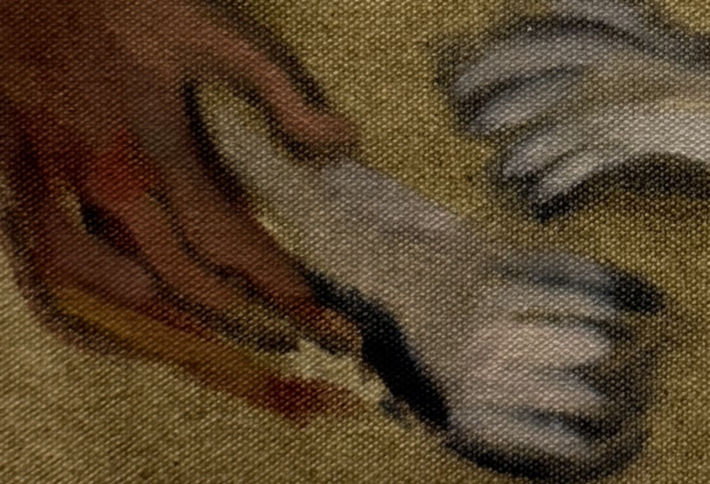
In the initial stage of creation, I chose "hands" as the core visual symbol to metaphorically represent power relationships within families. I viewed hands as body parts that could reveal more genuine information than faces, as we often neglect hand gestures while controlling facial expressions to conceal emotions. Hands are also crucial in human communication, symbolizing unity and connection through gestures like holding hands - an insight I gained from observing dance patterns on painted pottery and Botticelli's depiction of the three Fates dancing hand in hand in "Primavera."
My inspiration came from an old family photograph featuring myself, my mother, my father's sisters, and my paternal grandmother. While appearing to be a harmonious family portrait, I sensed a unique pressure among the women - a tension arising from the implicit struggle for influence over the education of the new family's child between non-blood-related family members. Though seemingly harmonious, the photograph concealed underlying conflicts.
Initially, I attempted to depict hands surrounding me - those of my mother and aunts - to represent these tense family dynamics. However, when I actually began painting hands, I found this literal representation too concrete and limiting, unable to fully express my ideas. This realization led me to contemplate how to more effectively portray relationships that are simultaneously intimate yet distant, supportive yet oppressive, harmonious yet conflicting.




II. Evolution of Artistic Language:
From Figurative to Abstract
In search of new forms of expression, I began focusing on capturing expressions, particularly recording my own expressions when dealing with complex emotions, especially those tinged with subtle melancholy. I initially created small studies using watercolor, whose unpredictability and blurred effects produced images where specific individuals became indistinguishable. This effect resonated with the subtle and complex nature of Asian culture that I wished to express.
Marlene Dumas's work significantly influenced me during this period. Her portraits possess a quality reminiscent of ink paintings - though not meticulously detailed, they carry powerful emotional impact. This impression deepened after viewing her works during a gallery tour day, particularly her paintings focusing on partial facial expressions.
A crucial turning point came through a conversation with my tutor, Geraint. His appreciation for sketches I had intended to discard, encouraging me to create freely without excessive concern for meaning, greatly inspired me. This advice liberated my creative process and, paradoxically, helped me better identify the themes I wanted to express.

face


III. Unity of Material Language and Concept


In my final works, I chose brown as the primary color, which closely matches the linen canvas base and resembles skin tone. The large particles in brown pigments create unique precipitation effects when diluted, reminiscent of skin pores or spots, enhancing the work's physicality and intimacy.
In the paintings, both figures share the same paint base, with similar colors and blurred boundaries representing their inseparable relationship. I applied heavy, clear brushstrokes in the background and gaps between figures, suggesting that while they occupy the same space, each exists in their own world.
I deliberately removed traditional feminine symbols like long hair and bangs, making the figures more gender-neutral. This treatment transcended specific gender limitations, focusing instead on universal human experiences. As one tutor noted, these figures appear "alien-like," which perfectly aligns with my understanding of relationships as something intangible and indescribable.

IV. Deepening of Theme:
Multiple Dimensions of Intimacy
During the creative process, the emergence of the concept "intimacy" was a crucial confirmation point. It helped me more clearly recognize the core theme I was exploring. This led me to contemplate multiple definitions of intimacy: Does blood relation necessarily equate to intimacy? Do different people understand intimate relationships in the same way?
These reflections prompted me to further reconsider my creative focus: Should I limit myself to power relationships within families, or expand to explore broader intimate relationships? I realized that it was precisely the lack of intimacy in family relationships that drove me to explore various forms of intimacy, including intimacy with oneself.
V.Trauma and Creation:
A Dialectical Relationship
Throughout the creative process, I gradually recognized the dual nature of my traumatic experiences, and this complex dialectical relationship directly influenced my artistic expression of family power dynamics. While these experiences made it difficult for me to build trust and often led to anxiety and self-doubt about my adequacy, from another perspective, these traumatic experiences themselves became a driving force. It was precisely these experiences that cultivated my unique capacity for self-reflection, distinguishing me from my peers and constantly pushing me to improve. This paradoxical nature of both limitation and benefit motivated me to pursue ambiguous and complex forms of expression in my work, attempting to capture the ineffable subtleties within family relationships.
The skin-like texture in my works hints at this vulnerability and sensitivity. Like the flow of paint, these experiences seem to be under my control yet possess their own trajectory of development. This uncontrollability has become an essential quality of the works, presenting an ineffable beauty and authenticity.
The creative process has helped me realize that these works are not merely expressions of personal experience but also explorations of universal human experiences. Through de-figurative treatment, the works provide viewers with an open space for interpretation, allowing them to project their own experiences. This possibility of resonance might be where the meaning of artistic creation lies.