Improvisation Within Discipline: Process Documentation of That Good Night
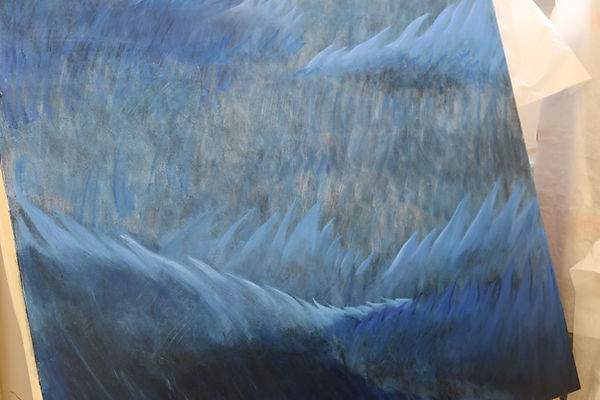
The creation of That Good Night (160×130 cm, 2024) is itself a case study of how "disciplinary body memory" and "improvisation" interact. This painting took 10 days to complete, during which the image transformed almost daily. These continuous transformations were not due to indecision, but because the act of painting became a "way of thinking"—hand movements preceding conscious judgment, bodily memory seeking its own rhythm on canvas.
The following photographs document key moments in this process. They do not showcase a linear progression from sketch to completion, but attempt to capture a more complex reality: painting as an open system, constantly self-adjusting, self-negating, self-regenerating. Each layer painted over is not an erasure of the previous one, but an accumulation and dialogue. As Camus spoke of "Sisyphean labor," each day's demolition and reconstruction constitutes the very substance of creation.
In this process, I sought "variation" within "rules" like a jazz musician: drawing discipline learned in childhood, etching techniques from undergraduate study—these techniques internalized into natural hand movements gained new freedom before the 160×130 cm canvas. Recurring elements in the image—the moon, horizon, solitary figures—function like leitmotifs in music, acquiring new meaning with each repetition.
This creative method echoes Merleau-Ponty's observation: "It is by lending his body to the world that the painter transforms the world into painting." In creating That Good Night, my body serves as both tool and subject, executing discipline while seeking breakthrough. The following photographs document this continuous, generative dialogue between body and canvas.